Catalog
Quadruple Differential Line Receiver
Key Features
• Meets or exceeds the requirements of ANSI TIA/EIA-422-B, TIA/EIA-423-B, and ITU recommendation V.10 and V.11Low power, I CC = 10 mA typical±7-V Common-mode range with ±200-mV sensitivityInput hysteresis: 60 mV typicalt pd = 17 ns typicalOperates from a single 5-V supply3-State outputsInput fail-safe circuitryImproved replacements for AM26LS32 deviceAvailable in Q-temp automotiveMeets or exceeds the requirements of ANSI TIA/EIA-422-B, TIA/EIA-423-B, and ITU recommendation V.10 and V.11Low power, I CC = 10 mA typical±7-V Common-mode range with ±200-mV sensitivityInput hysteresis: 60 mV typicalt pd = 17 ns typicalOperates from a single 5-V supply3-State outputsInput fail-safe circuitryImproved replacements for AM26LS32 deviceAvailable in Q-temp automotive
Description
AI
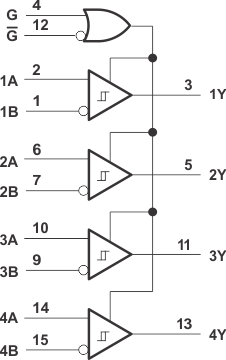
The AM26C32 device is a quadruple differential line receiver for balanced or unbalanced digital data transmission. The enable function is common to all four receivers and offers a choice of active-high or active-low input. The 3-state outputs permit connection directly to a bus-organized system. Fail-safe design specifies that if the inputs are open, the outputs always are high. The AM26C32 devices are manufactured using a BiCMOS process, which is a combination of bipolar and CMOS transistors. This process provides the high voltage and current of bipolar with the low power of CMOS to reduce the power consumption to about one-fifth that of the standard AM26LS32, while maintaining AC and DC performance.
The AM26C32 device is a quadruple differential line receiver for balanced or unbalanced digital data transmission. The enable function is common to all four receivers and offers a choice of active-high or active-low input. The 3-state outputs permit connection directly to a bus-organized system. Fail-safe design specifies that if the inputs are open, the outputs always are high. The AM26C32 devices are manufactured using a BiCMOS process, which is a combination of bipolar and CMOS transistors. This process provides the high voltage and current of bipolar with the low power of CMOS to reduce the power consumption to about one-fifth that of the standard AM26LS32, while maintaining AC and DC performance.