ADS6423 Series
Quad-Channel, 12-Bit, 80-MSPS Analog-to-Digital Converter (ADC)
Manufacturer: Texas Instruments
Catalog
Quad-Channel, 12-Bit, 80-MSPS Analog-to-Digital Converter (ADC)
Key Features
• 12-Bit Resolution With No Missing CodesSimultaneous Sample and Hold3.5dB Coarse Gain and upto 6dB ProgrammableFine Gain for SFDR/SNR Trade-OffSerialized LVDS Outputs With ProgrammableInternal Termination OptionSupports Sine, LVCMOS, LVPECL, LVDS ClockInputs and Amplitude down to 400 mVPPInternal Reference With External Reference SupportNo External Decoupling Required for References3.3-V Analog and Digital Supply64 QFN Package (9 mm × 9 mm)Pin Compatible 14-Bit Family (ADS644X - SLAS531A)Feature Compatible Dual Channel Family(ADS624X - SLAS542A, ADS622X - SLAS543A)12-Bit Resolution With No Missing CodesSimultaneous Sample and Hold3.5dB Coarse Gain and upto 6dB ProgrammableFine Gain for SFDR/SNR Trade-OffSerialized LVDS Outputs With ProgrammableInternal Termination OptionSupports Sine, LVCMOS, LVPECL, LVDS ClockInputs and Amplitude down to 400 mVPPInternal Reference With External Reference SupportNo External Decoupling Required for References3.3-V Analog and Digital Supply64 QFN Package (9 mm × 9 mm)Pin Compatible 14-Bit Family (ADS644X - SLAS531A)Feature Compatible Dual Channel Family(ADS624X - SLAS542A, ADS622X - SLAS543A)
Description
AI
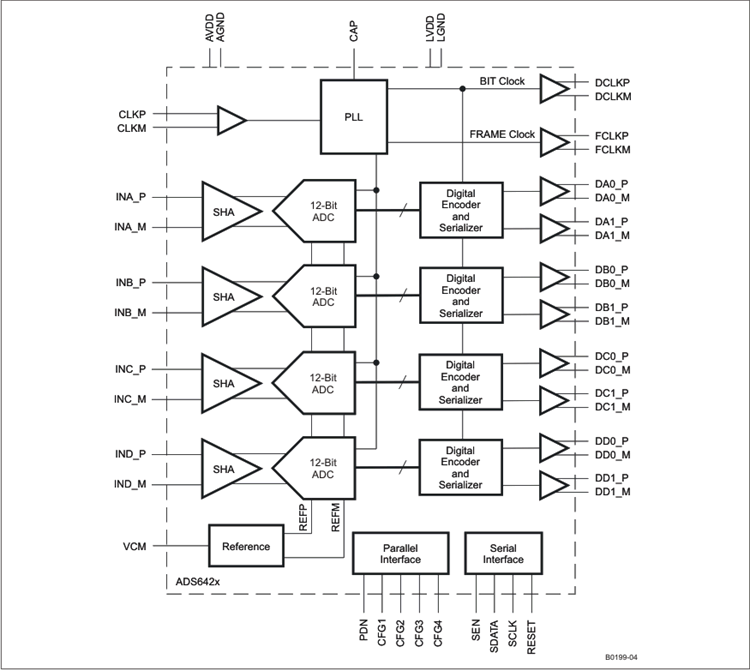
The ADS6424/ADS6423/ADS6422 (ADS642X) is a family of high performance 12-bit 105/80/65 MSPS quad channel A-D converters. Serial LVDS data outputs reduce the number of interface lines, resulting in a compact 64-pin QFN package (9 mm × 9 mm) that allows for high system integration density. The device includes 3.5dB coarse gain option that can be used to improve SFDR performance with little degradation in SNR. In addition to the coarse gain, fine gain options also exist, programmable in 1dB steps up to 6dB.
The output interface is 2-wire, where each ADC data is serialized and output over two LVDS pairs. This makes it possible to halve the serial data rate (compared to a 1-wire interface) and restrict it to less than 1Gbps easing receiver design. The ADS642X also includes the traditional 1-wire interface that can be used at lower sampling frequencies.
An internal phase lock loop (PLL) multiplies the incoming ADC sampling clock to derive the bit clock. The bit clock is used to serialize the 12-bit data from each channel. In addition to the serial data streams, the frame and bit clocks are also transmitted as LVDS outputs. The LVDS output buffers have features such as programmable LVDS currents, current doubling modes and internal termination options. These can be used to widen eye-openings and improve signal integrity, easing capture by the receiver.
The ADC channel outputs can be transmitted either as MSB or LSB first and 2s complement or straight binary.
ADS642X has internal references, but can also support an external reference mode. The device is specified over the industrial temperature range (–40°C to 85°C).
The ADS6424/ADS6423/ADS6422 (ADS642X) is a family of high performance 12-bit 105/80/65 MSPS quad channel A-D converters. Serial LVDS data outputs reduce the number of interface lines, resulting in a compact 64-pin QFN package (9 mm × 9 mm) that allows for high system integration density. The device includes 3.5dB coarse gain option that can be used to improve SFDR performance with little degradation in SNR. In addition to the coarse gain, fine gain options also exist, programmable in 1dB steps up to 6dB.
The output interface is 2-wire, where each ADC data is serialized and output over two LVDS pairs. This makes it possible to halve the serial data rate (compared to a 1-wire interface) and restrict it to less than 1Gbps easing receiver design. The ADS642X also includes the traditional 1-wire interface that can be used at lower sampling frequencies.
An internal phase lock loop (PLL) multiplies the incoming ADC sampling clock to derive the bit clock. The bit clock is used to serialize the 12-bit data from each channel. In addition to the serial data streams, the frame and bit clocks are also transmitted as LVDS outputs. The LVDS output buffers have features such as programmable LVDS currents, current doubling modes and internal termination options. These can be used to widen eye-openings and improve signal integrity, easing capture by the receiver.
The ADC channel outputs can be transmitted either as MSB or LSB first and 2s complement or straight binary.
ADS642X has internal references, but can also support an external reference mode. The device is specified over the industrial temperature range (–40°C to 85°C).